Tag: baseball history

  • Why Every MLB Baseball Gets Rubbed With Secret Mud Before the First Pitch

    Why Every MLB Baseball Gets Rubbed With Secret Mud Before the First Pitch

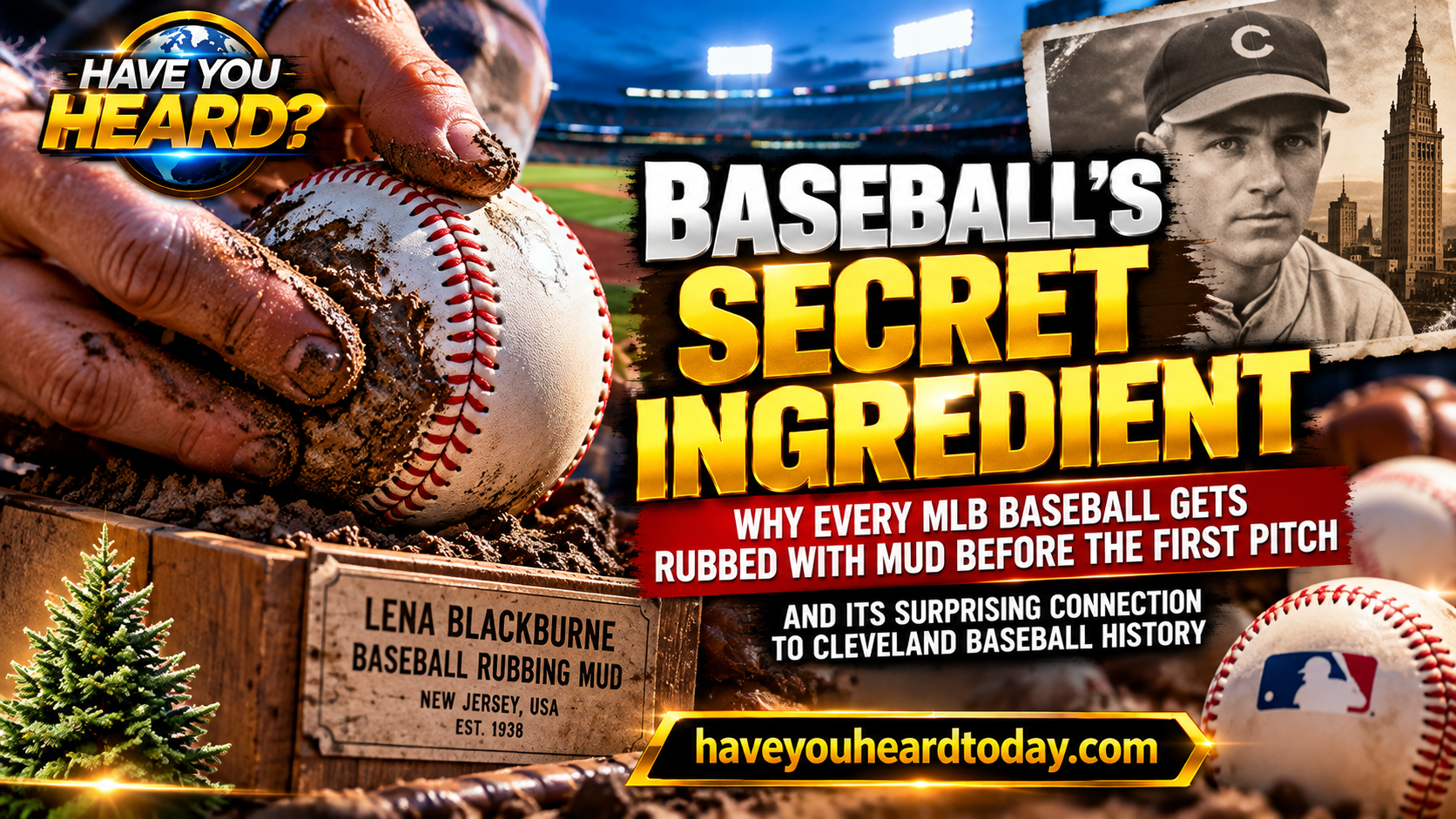
    Every Major League Baseball game begins with a secret most fans never notice. Before the first pitch is thrown, the baseballs have already undergone an unusual preparation process involving a special mud collected from a closely guarded location in New Jersey.

    It’s called Lena Blackburne Baseball Rubbing Mud, and this remarkable baseball tradition has survived for generations.

    But why does a professional sport that relies on advanced technology still depend on something as ordinary as mud?

    The answer involves slippery baseballs, an innovative former player, and a tragic chapter of Cleveland baseball history.

    Why Are MLB Baseballs Rubbed With Mud?

    Brand-new baseballs have a smooth, glossy leather surface. Although they look perfect coming out of the box, that finish can make them difficult for pitchers to grip.

    To prepare the balls for professional play, clubhouse personnel rub them with a specially processed mud that reduces the shine and improves the feel of the leather.

    The objective is to make the baseball easier to handle without excessively staining, scratching or damaging its surface.

    Major League Baseball’s rules require game balls to be properly rubbed so their gloss is removed.

    The Secret Mud Comes From New Jersey

    For decades, MLB teams have relied on Lena Blackburne Baseball Rubbing Mud, a substance harvested from a carefully protected location in southern New Jersey.

    Its unusually fine texture makes it suitable for preparing baseballs without the problems associated with ordinary dirt.

    Although the general region is known, the precise harvesting location and preparation methods have traditionally been closely guarded by the people responsible for the product.

    That secrecy has become part of baseball folklore.

    Who Was Lena Blackburne?

    Russell Aubrey “Lena” Blackburne was a former Major League player, manager and coach who helped transform how baseballs were prepared.

    In 1938, while coaching for the Philadelphia Athletics, Blackburne learned that umpires were frustrated with existing methods of removing the gloss from new baseballs.

    Some methods involved ordinary dirt, water, tobacco juice or other substances that could stain or damage the leather.

    Blackburne remembered a particularly fine mud he had encountered during his youth near the Delaware River in New Jersey.

    He experimented with that material and developed a preparation that proved effective for baseballs.

    His product spread through professional baseball, eventually becoming a familiar part of Major League game preparation.

    The Tragic Cleveland Connection

    One of the most important chapters in baseball safety history involves Cleveland shortstop Ray Chapman.

    On August 16, 1920, Chapman was struck in the head by a pitch thrown by New York Yankees pitcher Carl Mays. Chapman died the following day.

    His death intensified concerns about player safety and the condition and visibility of baseballs used during games.

    In the years that followed, baseball introduced changes intended to improve how balls were handled, including efforts to ensure that clean, properly prepared baseballs were available.

    Blackburne’s rubbing mud was introduced nearly two decades later, in 1938.

    Although Chapman’s death did not directly create the mud product, both stories belong to the larger history of baseball’s efforts to improve the safety and handling of game balls.

    Does Every MLB Team Use the Same Mud?

    According to Major League Baseball, teams use Lena Blackburne Baseball Rubbing Mud as part of their standard preparation process.

    Before games, clubhouse personnel prepare numerous baseballs, rubbing the surface to reduce its factory gloss.

    This happens before fans see those baseballs delivered to the field.

    While pitchers are subject to strict rules regarding unauthorized foreign substances, the approved pregame preparation of baseballs is a separate, established procedure.

    Why Hasn’t Technology Replaced the Mud?

    Baseball equipment has evolved considerably, yet the mud tradition has endured.

    The challenge is straightforward: a baseball must offer an appropriate grip while preserving the characteristics required for professional competition.

    MLB has explored alternative baseball surfaces and preparation methods, but Lena Blackburne’s mud remains a longstanding part of the sport.

    It is an unusual reminder that sometimes a simple material can continue serving a specialized purpose even as the surrounding sport becomes more technologically advanced.

    The HYH Bottom Line

    The next time you watch a Major League Baseball game, remember that the baseball leaving a pitcher’s hand has a story of its own.

    Before it reaches the mound, it has been carefully prepared using a substance with roots in a New Jersey mud bank and a tradition dating to 1938.

    And the larger history of baseball safety includes a lasting connection to Cleveland’s Ray Chapman.

    Have You Heard? One of baseball’s most enduring secrets isn’t hidden inside the ball. It’s rubbed onto the outside.

    Sources and Further Reading

  • Yankees vs. Red Sox Again: The Surprisingly Short Postseason History of Baseball’s Biggest Rivalry

    Yankees vs. Red Sox Again: The Surprisingly Short Postseason History of Baseball’s Biggest Rivalry

    Few rivalries in American sports are as famous as the New York Yankees and Boston Red Sox. Their history stretches back more than a century, filled with legendary players, dramatic games, and generations of fans who grew up choosing a side.

    But here’s the surprising part: despite all that history, the Yankees and Red Sox did not meet in the postseason until 1999.

    Now, in 2026, they are meeting again in the American League Wild Card Series. It will be only the seventh official postseason series between the two clubs — a remarkably small number considering how closely their histories are connected.

    Why Did It Take Until 1999

    For most of baseball history, the postseason format made a Yankees–Red Sox October matchup extremely difficult. For decades, only the team that finished first in its league advanced directly to the World Series. Later, when divisional play and the League Championship Series were introduced, teams from the same division still had limited paths to face one another in October.

    That changed with Major League Baseball’s Wild Card era. MLB realigned into three divisions per league in 1994 and added a Wild Card spot, allowing a strong second-place team to reach the postseason. Because the 1994 season ended early due to the players’ strike, the new format was first used in 1995.

    By 1999, the pieces finally fell into place. The Yankees won the American League East, while Boston reached the postseason as the AL Wild Card. Both teams advanced through the Division Series, setting up their first-ever postseason meeting in the American League Championship Series. New York won that series 4–1.

    When the Rivalry Finally Reached October

    Once the Yankees and Red Sox finally met in the postseason, the rivalry quickly produced some of baseball’s most memorable October moments.

    Their first matchup came in the 1999 American League Championship Series, when New York won 4–1 before going on to win the World Series. Four years later, the teams met again in the 2003 ALCS, a seven-game battle remembered for Aaron Boone’s walk-off home run in Game 7.

    Then came 2004. The Yankees took a 3–0 series lead in the ALCS, but Boston became the first team in MLB history to come back from a 3–0 deficit in a postseason series. The Red Sox won four straight games, captured the pennant, and later won their first World Series championship since 1918

    The teams met again in the 2018 ALDS, the 2021 AL Wild Card Game, and the 2025 Wild Card Series. By the time they reached another Wild Card matchup in 2026, the rivalry had accumulated only a small number of postseason series despite more than a century of history between the franchises.

    Why the 2004 Comeback Still Defines the Rivalry

    The 2004 American League Championship Series remains one of the most dramatic chapters in Yankees–Red Sox history. New York won the first three games and appeared headed for a sweep, putting Boston one loss away from elimination.

    In Game 4, the Red Sox were down by a run in the ninth inning when Dave Roberts entered as a pinch-runner and stole second base. Bill Mueller then singled him home to tie the game. David Ortiz eventually ended it with a two-run walk-off home run in the 12th inning. The next night, Ortiz delivered another walk-off hit as Boston won Game 5 in 14 innings.

    Boston went on to win Games 6 and 7 at Yankee Stadium, becoming the first team in MLB postseason history to win a series after trailing three games to none. The Red Sox then swept the St. Louis Cardinals in the World Series, winning their first championship since 1918.

    So Why Have They Met So Few Times?

    Even after MLB expanded the postseason, the format continued to make Yankees–Red Sox matchups relatively difficult. From 1995 through 2011, a Wild Card team could not face a division winner from its own division in the Division Series. Because New York and Boston both play in the AL East, they generally had to survive separate Division Series before they could meet in the AL Championship Series.

    That restriction disappeared in 2012, when MLB added a second Wild Card team to each league. The postseason expanded again in 2022 to three Wild Card teams per league and a best-of-three Wild Card Series, creating more possible paths for division rivals to face one another in October.

    So the surprisingly small number of Yankees–Red Sox postseason meetings is not because the rivalry lacked importance. For much of baseball history, the playoff structure itself kept two teams from the same division apart—or made them survive multiple rounds before they could finally meet.

    Why the 2026 Rematch Is Different

    This year’s Wild Card Series adds another unusual chapter to the rivalry: the Yankees and Red Sox are meeting in the postseason for the second consecutive year. New York defeated Boston in three games in the 2025 Wild Card Series, and the two clubs are back at Yankee Stadium again in 2026.

    The matchup was close throughout the 2026 regular season. The Yankees won the season series 7–6, including a 4–2 record against Boston at Yankee Stadium. As the higher seed, New York will host the entire best-of-three Wild Card Series.

    Game 1 is scheduled for September 29 at 8 p.m. ET, with Game 2 the following night and Game 3, if necessary, on October 1.

    A Rivalry Bigger Than Its Postseason Record

    The Yankees–Red Sox rivalry has never needed October to feel important. Decades of regular-season battles, championship races, unforgettable players, and dramatic moments built its reputation long before the teams finally faced each other in the postseason in 1999. MLB’s own postseason history shows just how rare those October meetings have been compared with the size of the rivalry itself

    That scarcity may actually be part of what makes their postseason meetings feel so significant. When New York and Boston do meet in October, the games carry generations of history with them — from the Yankees’ early postseason wins to Boston’s historic 2004 comeback and the Wild Card battles that followed.

    The 2026 Wild Card Series adds another chapter, but the larger story remains the same: one of baseball’s most famous rivalries has produced surprisingly few postseason meetings. For a matchup that feels almost constant, its October history is remarkably compact.

    Sources

    MLB — Red Sox–Yankees Postseason History

    MLB — Wild Card History

    MLB — 1999 Postseason Recap

    MLB — 2026 Wild Card Series Matchups