HYH ORIGINAL | TECHNOLOGY & SOCIETY
From restaurant menus to parking meters and medical appointments, the smartphone is becoming more than a convenience. But what happens to people who don’t have one?
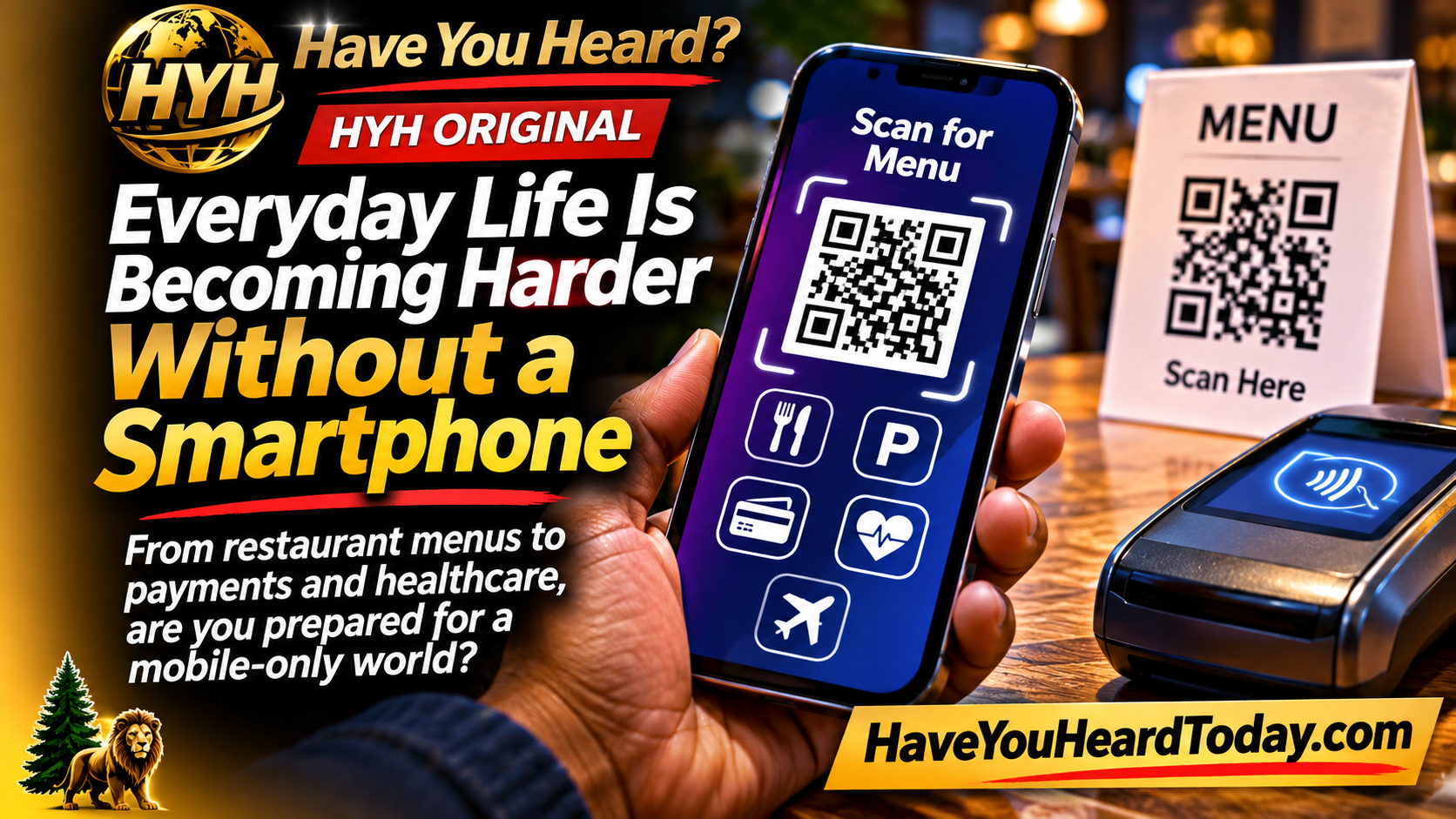
Imagine walking into a restaurant, sitting down, and discovering there are no printed menus. Instead, a small square code sits on the table.
You’re expected to scan it with your smartphone.
Now imagine you don’t own a smartphone. Or your battery is dead. Or you’ve left it at home.
Suddenly, something as ordinary as ordering lunch becomes more complicated.
Have you heard? The smartphone is increasingly becoming an unofficial admission ticket to everyday life.
And that raises a question Americans may need to start asking: Should owning a smartphone become a practical requirement for participating in modern society?
From Convenience to Expectation
Not long ago, a cellphone was primarily a communication device. People made calls, sent messages, and occasionally took photographs.
Today, smartphones can serve as wallets, boarding passes, identification tools, navigation systems, appointment schedulers, and digital keys.
That convenience has transformed everyday life. But it has also changed what businesses and institutions expect from customers.
At some restaurants, QR codes replace printed menus. Certain parking systems encourage or require mobile payment. Entertainment venues increasingly offer digital tickets. Some healthcare providers encourage patients to manage appointments and paperwork through online portals.
These systems are not universal, and alternatives remain available in many places. Nevertheless, the direction is difficult to overlook.
Millions of Americans Still Don’t Own Smartphones
According to research published by the Pew Research Center in October 2026, approximately 91% of American adults own smartphones.
That leaves roughly 9% who do not report owning one.
Among adults ages 65 and older, smartphone ownership is approximately 79%, according to the same research.
These figures reveal an important distinction: A technology can be extremely popular without being universally accessible.
And the challenge is not limited to older Americans.
People may avoid smartphones because of cost, privacy concerns, disabilities, personal preferences, unreliable service, or simply because they do not want another monthly expense.
What Happens When Your Phone Stops Working?
Consider a familiar situation.
You’re away from home, your phone battery reaches zero, and you suddenly realize how many everyday activities depend on that device.
Your parking payment may require an app. Your event ticket may be stored digitally. Your rideshare account, navigation directions, and banking verification codes may all be inaccessible.
For many people, the inconvenience is temporary.
For someone without reliable access to a smartphone, however, those obstacles may be part of everyday life.
The deeper issue is not whether smartphones are useful. Clearly, they are.
The issue is whether services are preserving reasonable alternatives for customers who cannot use them.
When Digital Convenience Creates New Barriers
Businesses have understandable reasons for embracing mobile technology.
Digital systems can simplify transactions, update information quickly, reduce some administrative tasks, and make services available outside normal business hours.
But a system that saves time for one customer may create difficulty for another.
A QR-code menu is convenient for someone with a charged smartphone and reliable internet service. It may be frustrating for someone with limited vision, an older device, or no smartphone at all.
A digital-only payment process can be efficient for regular app users while excluding people who prefer cash or physical cards.
Even smartphone owners can face difficulties when an app crashes, a password is forgotten, or mobile service becomes unavailable.
Technology works best when convenience does not come at the expense of basic accessibility.
The Smartphone Has Become an Essential Internet Connection
Another surprising development is that some Americans depend on smartphones as their primary connection to the internet.
Pew Research Center reports that 16% of U.S. adults in 2026 own a smartphone but do not subscribe to home broadband service.
For these households, a phone is not merely an accessory. It may be their main connection to employment opportunities, financial services, educational resources, government information, and family communication.
That dependence makes affordability, connectivity, and reliable service especially important.
Should Businesses Always Offer Another Option?
Imagine a restaurant that provides both QR-code and printed menus.
Or a parking facility that accepts mobile payments while retaining a card-payment machine.
Or a medical office that offers online scheduling without eliminating telephone appointments.
These approaches demonstrate that technological progress and customer choice do not have to compete.
Maintaining alternatives may involve additional costs or operational challenges. Still, accessibility deserves consideration whenever organizations redesign essential services.
The objective should not be to discourage innovation. It should be to ensure that innovation remains useful to the broadest possible public.
A Future Where Everything Is Connected
Smartphones have transformed how Americans communicate, shop, travel, and access information.
Many of those changes have made life easier.
Yet the rapid adoption of mobile technology presents a question that deserves more public attention.
When an everyday service becomes dependent on a particular device, is that still a convenience — or has it become a requirement?
And if it becomes a requirement, what happens to people who cannot afford the device, cannot operate it, or simply choose not to own one?
The HYH Perspective: Progress Should Leave Room for Everyone
Technology will continue evolving. Businesses will continue developing faster payment systems, smarter applications, and new ways to serve customers.
Those developments can be beneficial.
But progress should also be measured by how well it serves people with different needs, resources, and abilities.
Perhaps the most useful future is not one where every activity requires a smartphone.
Perhaps it is one where technology makes life easier without taking away reasonable alternatives.
Have you heard? The next great technological innovation might not be another app. It might be remembering to give people a choice.
Sources and Further Reading
- Pew Research Center — Mobile Device Ownership and Smartphone Dependency, 2026
- Pew Research Center — Internet Use, Smartphone Ownership and Digital Divides
- ADA.gov — Guidance on Web Accessibility
HYH Original Explainer | HaveYouHeardToday.com