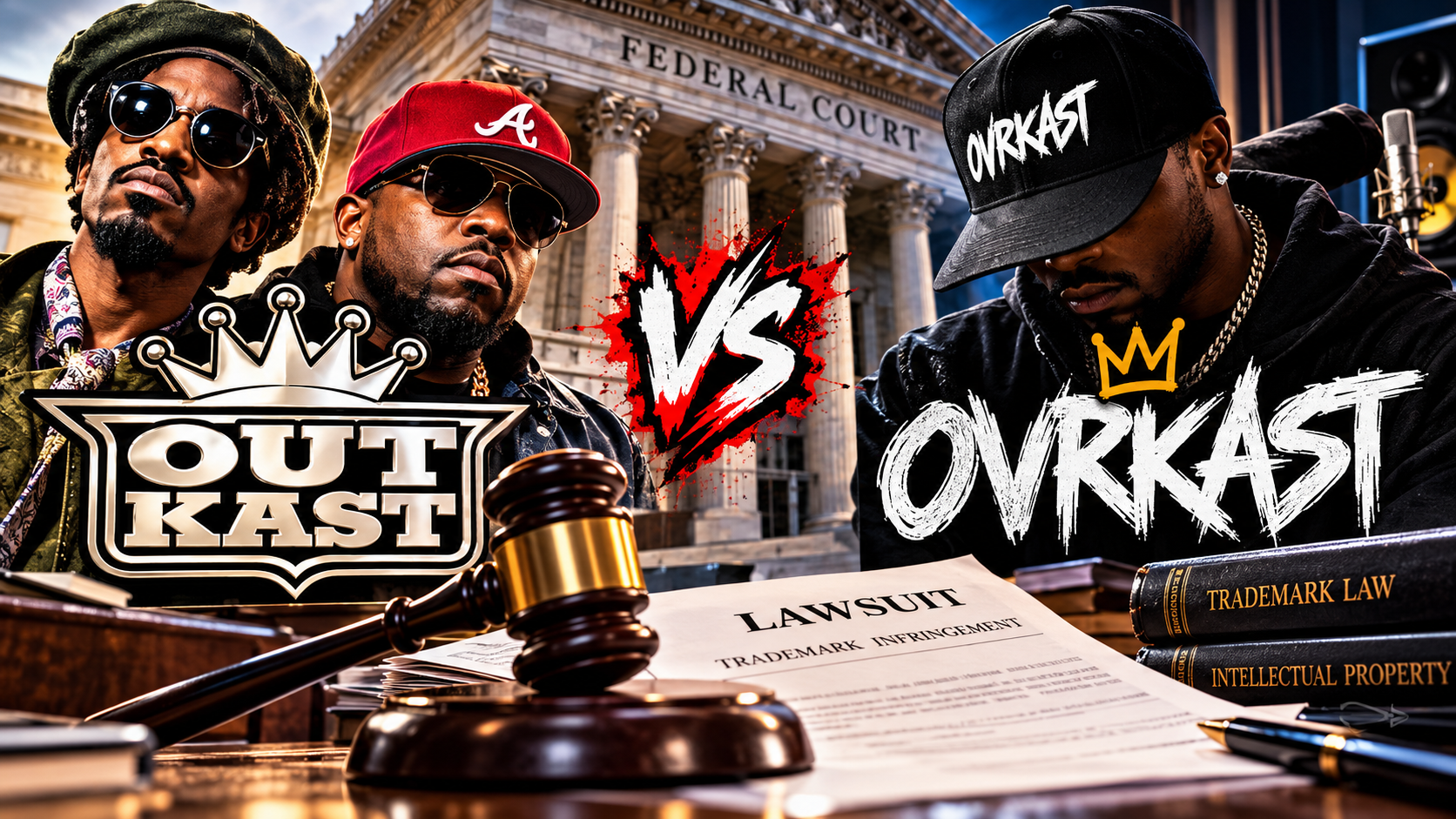
Editorial illustration created for Have You Heard? This is not a photograph from the court proceedings.
A dispute over two remarkably similar names has moved from the recording studio into federal court.
High Schoolers, LLC, the company that controls trademarks associated with legendary Atlanta hip-hop duo Outkast, filed a lawsuit on September 16, 2026, against rapper and producer Silas Wilson, professionally known as Ovrkast.
The case was filed in the U.S. District Court for the Northern District of Georgia and alleges trademark infringement, unfair competition, trademark dilution, breach of contract and several other claims. The complaint contains 10 counts and requests a jury trial.
But this is not simply a case of one artist discovering another artist with a similar name.
According to the lawsuit, the two sides had already spent more than a year attempting to resolve the dispute privately before negotiations collapsed.
Ovrkast, meanwhile, is publicly challenging an important part of Outkast’s version of events.And that disagreement may become one of the most interesting parts of the case.
Who Actually Filed the Lawsuit?
Technically, André 3000 and Big Boi are not individually listed as the plaintiff.
The plaintiff is High Schoolers, LLC, which the complaint describes as Outkast’s trademark-holding company and says is controlled by André Benjamin and Antwan Patton — better known as André 3000 and Big Boi.
The company says Outkast has continuously used its name since the duo formed in 1993.
The complaint points to Outkast’s decades of commercial success, six Grammy Awards, more than 25 million records sold and its 2025 induction into the Rock & Roll Hall of Fame as evidence of the name’s enormous recognition and commercial value. Those descriptions are allegations and representations made by the plaintiff in its filing.
High Schoolers also identifies several federal trademark registrations covering the Outkast name for music recordings, clothing and entertainment services.
Why Outkast Says the Names Are Too Similar
At the center of everything are two words:
OUTKAST
and
OVRKAST
High Schoolers argues that the names are so similar that listeners could mistakenly believe Ovrkast is connected with, sponsored by or otherwise affiliated with Outkast.
The lawsuit goes further, alleging that Wilson selected his professional name while aware of Outkast and intending either to benefit from the group’s fame or at least evoke it in consumers’ minds. Wilson disputes that characterization.
Under U.S. trademark law, two names do not necessarily need to be spelled identically for a conflict to exist.
The U.S. Patent and Trademark Office explains that trademarks may be considered confusingly similar because of their appearance, sound, meaning or overall commercial impression. Whether the products or services associated with the marks are related is also important.
That principle is particularly relevant here because both names are being used within the music industry.
The 2025 Cease-and-Desist
According to the complaint, High Schoolers’ attorneys contacted Wilson on June 18, 2025, sending a cease-and-desist letter demanding that he discontinue use of the Ovrkast name.
Rather than immediately taking the fight to court, the parties entered negotiations.
High Schoolers says those discussions eventually resulted in terms under which Wilson would phase out OVRKAST across his website, social accounts, streaming profiles, advertising, merchandise and other uses.
The proposed replacement?
OVERKXST.
The complaint says that name had been approved by High Schoolers.
The Proposed Name Change to OVERKXST
The negotiations continued into 2026.
According to High Schoolers, Wilson’s attorney requested on April 7 that the deadline for completing the switch be extended until July 15, 2026.
High Schoolers says it accepted that request and sent a finalized settlement agreement three days later.
But there is one fact on which both the reporting and complaint are especially important:
Wilson never signed that final document.
That does not automatically answer whether an enforceable agreement existed.
And that leads directly to the biggest disagreement between the two sides.
The Major Disagreement: Was There Really a Binding Agreement?
High Schoolers argues that the parties had already agreed to the material terms during negotiations and that the resulting settlement was therefore binding despite the lack of Wilson’s signature.
The company says Wilson later delayed completing the paperwork and continued using Ovrkast beyond the proposed July 15 transition date.
Wilson tells a different story.
After news of the lawsuit surfaced, he publicly stated that he never signed an agreement and said he had attempted to cooperate and suggest alternatives during the discussions.
That means the dispute is about more than trademark similarity.
The court may ultimately also have to address whether negotiations conducted through the parties’ attorneys created an enforceable settlement even without Wilson signing the final document.
No court has yet resolved that question in this case.
Ovrkast Pushes Back
On September 26, Ovrkast gave a more extensive response.
He said his professional identity had been developed independently of Outkast and denied ever intending to imitate the legendary group or mislead listeners.
He also expressed respect for Outkast and said he hopes the dispute can ultimately be resolved in a way that allows him to continue building his own place in hip-hop.
That response is important because intent is one of several factors courts may consider in trademark infringement disputes — although it is not the only one.
The USPTO explains that courts can consider similarity between the marks, the strength of the older mark, how the parties market their products, their audiences, evidence of actual confusion and the defendant’s intent, among other factors.
Why “Consumer Confusion” Matters
One of the most interesting pieces of evidence cited by High Schoolers comes from Ovrkast himself.
During a 2025 Rolling Stone interview, Wilson discussed people sometimes reading his name as Outkast and assuming there was some connection.
High Schoolers included that interview in its complaint and argues that Wilson’s comments demonstrate that confusion has actually occurred.
Wilson’s own explanation in that interview, however, was essentially the opposite: he said he had not been thinking about Outkast when choosing the name.
Those two interpretations illustrate the dispute perfectly.
High Schoolers views those encounters as evidence supporting its trademark claim.
Ovrkast views them as misunderstandings that do not mean he intentionally copied the group.
It will be up to the legal process — not either side’s public statements — to determine what significance that evidence ultimately carries.
What Outkast’s Company Wants From the Court
High Schoolers is asking for substantially more than a declaration that the names are similar.
The complaint seeks a permanent injunction that would prevent Wilson from continuing to use Ovrkast, as well as certain similar branding.
The company also seeks monetary relief, including profits connected to the disputed name, damages and attorneys’ fees. The filing does not state a specific overall dollar amount.
If the company ultimately obtained all of the requested relief, Wilson could also be required to remove the Ovrkast name from websites, social media and other platforms and surrender certain branded materials for destruction.
Those are requests made in the complaint — not remedies that have already been awarded.
Why This Case Matters to Artists and Producers
There is a bigger music-industry lesson buried inside this unusual hip-hop dispute.
A stage name is not merely something printed on an album cover anymore.
It can appear across Spotify, YouTube, Apple Music, merchandise, touring advertisements, websites, social media accounts and licensing deals.
For an artist who spends years developing an audience, changing that name can potentially mean rebuilding part of that identity.
At the same time, trademark owners have strong incentives to police their names because trademarks function as indicators of who produced or sponsored a particular product or service.
The USPTO specifically advises businesses to search for potentially conflicting trademarks because marks can conflict when they look or sound similar and are associated with related products or services.
For independent rappers and producers, the Outkast-Ovrkast fight is therefore about much more than one missing letter.
It demonstrates how something as basic as an artist name can eventually become a valuable piece of intellectual property — and potentially the subject of expensive federal litigation.
What Happens Next?
For now, the lawsuit remains pending.
The federal docket identifies the case as High Schoolers, LLC v. Wilson, Case No. 1:26-cv-05345, assigned to U.S. District Judge Eleanor L. Ross in the Northern District of Georgia.
Outkast’s trademark company has laid out its allegations.
Ovrkast has now publicly disputed important parts of them.
And no judge or jury has yet determined which side will prevail.
That leaves one very simple question hanging over one of hip-hop’s most unusual name disputes:
How similar is too similar?
Have you heard?
For the full story behind the headlines, keep following HaveYouHeardToday.com.
Sources
1. Federal complaint — High Schoolers, LLC v. Silas WilsonThe 31-page September 16 filing containing High Schoolers’ allegations, trademark information, negotiation timeline and requested relief.
2. Music Business Worldwide — Outkast’s trademark company sues rapper OvrkastDetailed reporting on the complaint, proposed OVERKXST name change and disputed settlement negotiations.
3. Rolling Stone — Ovrkast responds to Outkast lawsuitOvrkast’s September 26 response explaining his position that he developed the name independently and did not intend to confuse listeners.
4. U.S. Patent and Trademark Office — Likelihood of confusionOfficial background explaining why trademark disputes can involve similarity in appearance, sound, meaning and related goods or services.