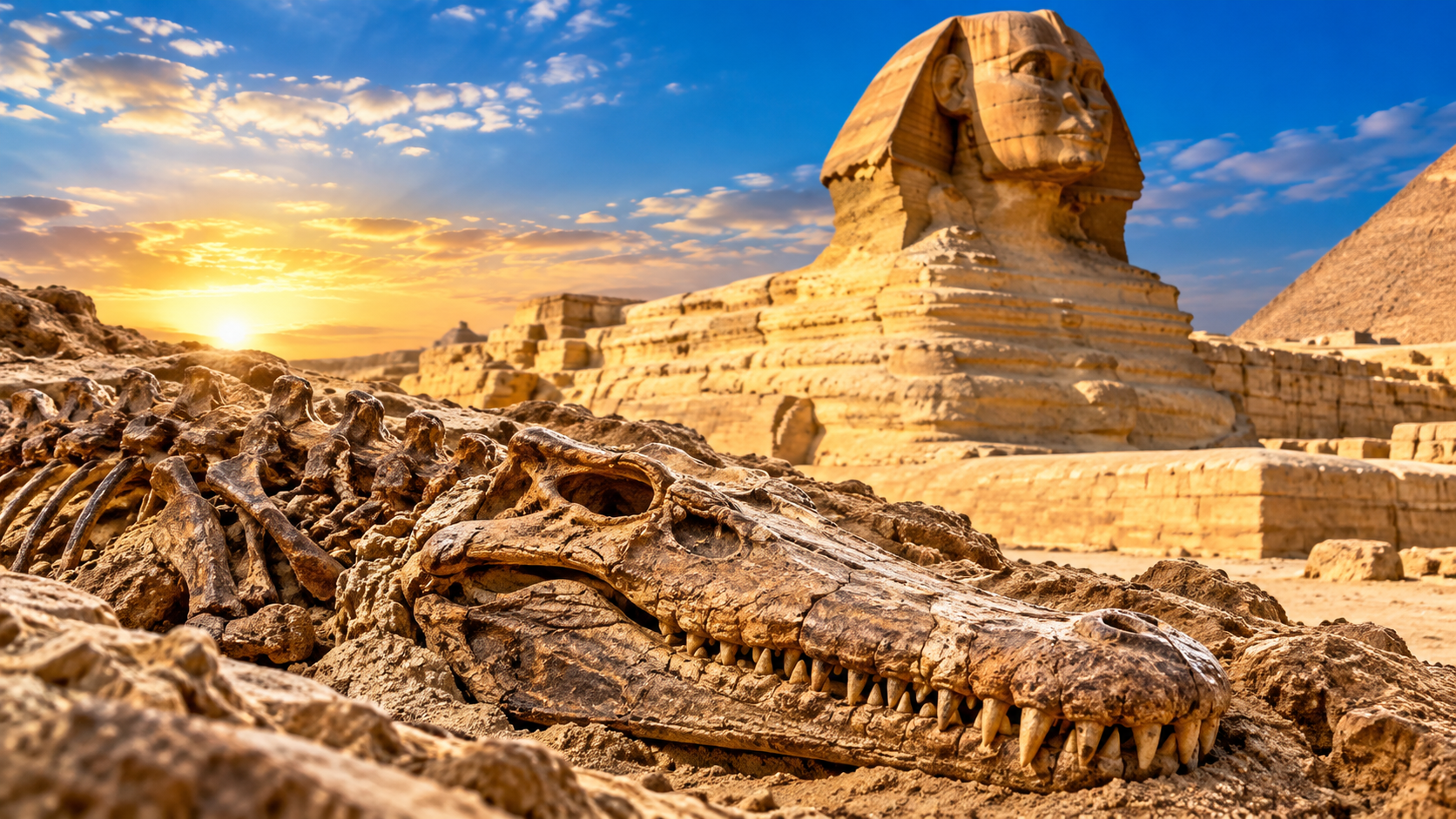
A fossil discovered nearly a century ago has revealed a previously unrecognized crocodile species—and an extraordinary coincidence involving one of Egypt’s most famous monuments.
What could a prehistoric crocodile possibly have in common with the Great Sphinx of Giza?
According to newly published scientific research, the answer lies in ancient limestone, a missing piece of a skull, and a discovery that is helping scientists reconstruct Egypt’s prehistoric past.
An international research team has identified an extinct crocodilian named Herugavialis cairensis, which lived approximately 45 million years ago in what is now Egypt.
Its fossils came from the Mokattam Formation—the same geological formation from which the Great Sphinx was carved.
And in a remarkable coincidence, both the fossil skull and the Great Sphinx are missing the tips of their noses.
A Discovery Nearly 100 Years in the Making
The story begins in the 1920s, when researchers recovered crocodilian fossils from Egypt’s Mokattam Formation, including a nearly complete skull.
At the time, scientists classified the remains as belonging to Tomistoma, a group that includes the modern false gharial, a long-snouted crocodilian found in Southeast Asia.
But advances in scientific technology gave researchers an opportunity to revisit that conclusion.
Using computed tomography, commonly known as CT scanning, an international team examined the fossil’s internal structures and identified anatomical differences that distinguished it from the living false gharial.
The findings led researchers to recognize a previously unknown genus and species: Herugavialis cairensis.
The study was published in October 2026 in the peer-reviewed journal Royal Society Open Science.
Why the Great Sphinx Connection Is So Unusual
The Great Sphinx of Giza was carved from limestone more than 4,000 years ago.
The newly identified crocodilian lived tens of millions of years before ancient Egyptian civilization existed. Yet its fossil was preserved in the same geological formation that later became part of Egypt’s monumental architectural history.
Researchers also noticed an unusual resemblance: the fossil crocodilian’s skull is missing the end of its snout, just as the Great Sphinx famously lacks its nose.
The scientists named the species Herugavialis cairensis partly in recognition of that coincidence. The name refers to Heru, an Egyptian deity associated with Horus.
This connection does not suggest that the crocodile lived alongside the builders of the Sphinx or that the Egyptians used its fossil in constructing the monument.
Instead, it illustrates how one landscape can preserve vastly different chapters of Earth’s history.
Egypt Once Looked Very Different
Today, the area around Cairo is associated with desert landscapes, ancient monuments, and the Nile River.
But approximately 45 million years ago, much of northern Egypt was covered by warm, shallow marine waters.
These environments supported prehistoric marine life, including fish and crocodilians adapted to hunting aquatic prey.
Herugavialis cairensis belonged to a group known as gavials, distinguished by their long, narrow snouts.
The researchers found evidence that several gavial species inhabited the region during this ancient period.
That means the waters covering prehistoric Egypt supported a much more diverse crocodilian community than modern geography might suggest.
Why This Discovery Matters Beyond the Fossil
The discovery offers more than the identification of another extinct animal.
It provides additional evidence that crocodilian evolution was closely connected to ancient marine environments, shifting coastlines, and changes in global climate.
Today, only two living gavial species remain, inhabiting freshwater environments in parts of South and Southeast Asia.
Their ancient relatives, however, occupied a much wider geographical range.
The Egyptian fossils help scientists investigate how those animals spread across different regions and why their distribution changed over millions of years.
The study also demonstrates the value of revisiting fossils already held in scientific collections.
A specimen discovered almost a century ago can still produce important new information when researchers apply modern technology and ask new questions.
A Landscape With Two Extraordinary Histories
The most fascinating aspect of this discovery may be the contrast between geological time and human history.
The Great Sphinx represents an achievement of ancient Egyptian civilization dating back thousands of years.
The limestone beneath it preserves evidence of environments and animals that existed tens of millions of years earlier.
One tells the story of human engineering, belief, and culture.
The other reveals a prehistoric world of warm seas and crocodilians whose descendants survive far from Egypt today.
Together, they remind us that even some of the world’s most familiar historical landmarks are part of a much older natural history.
And sometimes, discovering that history requires taking another look at something scientists found nearly 100 years ago.
Sources & References
- University College London — New Crocodile Species Discovery
- Royal Society Open Science — Original Scientific Research
- Mongabay — Crocodile Fossil and Great Sphinx Discovery