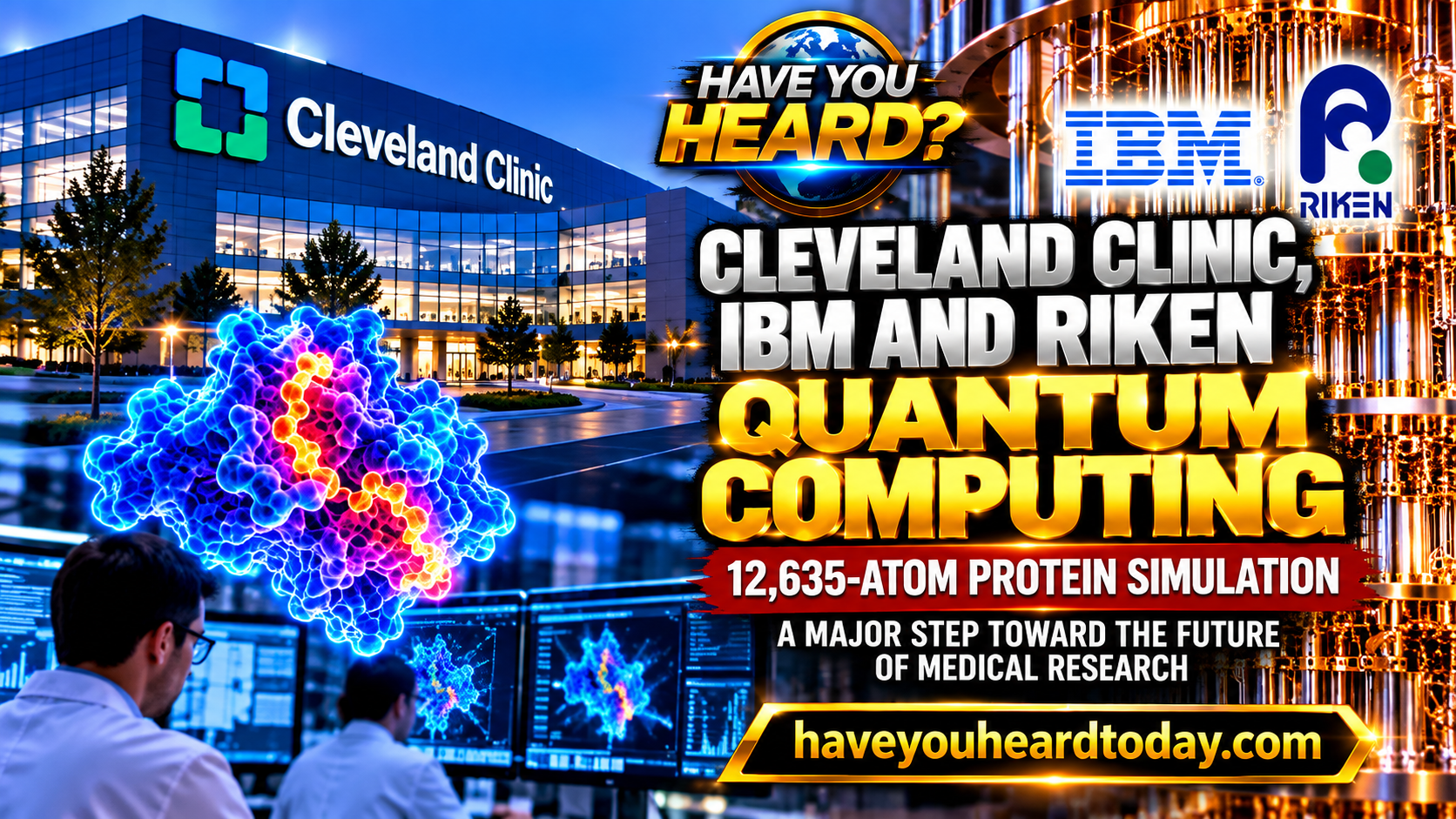
CLEVELAND, Ohio — A collaboration between Cleveland Clinic, IBM and Japan’s RIKEN research institute is exploring how quantum computing could help scientists better understand complex molecules, potentially opening new possibilities for future medical research and drug discovery.
The research team has demonstrated a hybrid quantum-classical approach to simulating a molecular system containing 12,635 atoms. The work, announced in May 2026, received further recognition when the collaboration was named a finalist for the 2026 ACM Gordon Bell Prize.
The achievement highlights the growing role of advanced computing in biomedical research, although practical medical applications remain a longer-term goal.
What Makes This Research Significant?
Proteins play essential roles throughout the human body. Understanding their structure, behavior and interactions with other molecules is critical to studying disease and developing potential treatments.
However, accurately modeling large molecular systems presents enormous computational challenges.
Researchers are investigating whether quantum computers, working alongside traditional supercomputers, can eventually tackle certain molecular calculations more effectively.
The Cleveland Clinic, IBM and RIKEN collaboration represents progress toward that objective.
A Simulation Involving 12,635 Atoms
Using IBM quantum technology and powerful classical computing resources, researchers simulated a protein-related molecular system containing 12,635 atoms.
The team employed a hybrid approach, combining quantum processors with conventional supercomputers to perform different portions of the calculations.
Rather than replacing traditional computers, the research explores how both technologies can work together to address complex scientific problems.
The simulation’s scale represents an important technical achievement, but it does not mean quantum computers can already solve every challenge associated with molecular modeling.
Why Cleveland Clinic Is Involved
Cleveland Clinic has been expanding its involvement in quantum computing research as part of its broader effort to advance biomedical discovery.
Through collaborations with IBM and international research institutions, scientists are investigating new computational methods that could eventually support research involving proteins, diseases and potential medicines.
The partnership also demonstrates Cleveland’s growing participation in advanced scientific computing.
Could Quantum Computing Transform Drug Discovery?
One potential application involves improving scientists’ ability to model interactions between molecules.
Drug discovery often requires researchers to examine how a potential medicine might interact with proteins associated with a disease.
More powerful simulation methods could eventually help researchers investigate these interactions and identify promising candidates for further laboratory testing.
However, important limitations remain. The latest achievement does not represent a newly developed drug, a clinical trial or an approved medical treatment.
Researchers must continue improving the reliability, accuracy and practical usefulness of quantum-based calculations before these techniques can become routine tools in drug development.
International Recognition for the Research
In September 2026, the Cleveland Clinic, IBM and RIKEN collaboration was named a finalist for the ACM Gordon Bell Prize, an award recognizing major achievements in high-performance computing.
The recognition reflects the scientific and technical significance of combining quantum computing with classical supercomputing for large-scale molecular simulations.
IBM also released a research video in October 2026 explaining the collaboration and its potential implications for computational science.
What Happens Next?
Quantum computing remains an emerging technology, and many challenges must be overcome before it can routinely outperform established methods in biomedical research.
Nevertheless, projects involving Cleveland Clinic, IBM and RIKEN demonstrate how researchers are moving beyond theoretical possibilities and testing these technologies on increasingly complex scientific problems.
For scientists studying proteins and molecular interactions, the long-term promise is the development of better computational tools that could contribute to future medical discoveries.
The HYH Bottom Line
Cleveland Clinic’s collaboration with IBM and RIKEN is helping advance research at the intersection of quantum computing and molecular science.
While the technology has not yet produced a new medical treatment, its continued development could influence how scientists study diseases and investigate future medicines.
Have You Heard? The future of medical research may depend not only on breakthroughs in laboratories, but also on breakthroughs in computing.
Sources and Further Reading
- Cleveland Clinic Newsroom — Official Research Announcements
- IBM Quantum Blog — Quantum Computing Research
- RIKEN — Official Research Institute
- Association for Computing Machinery — Awards and Research News
- Wikimedia Commons — Cleveland Clinic, IBM and RIKEN Research Footage
HYH Editorial Note: This article reports on scientific computing research. The findings do not establish that quantum computing has produced an approved treatment or demonstrated improved patient outcomes.