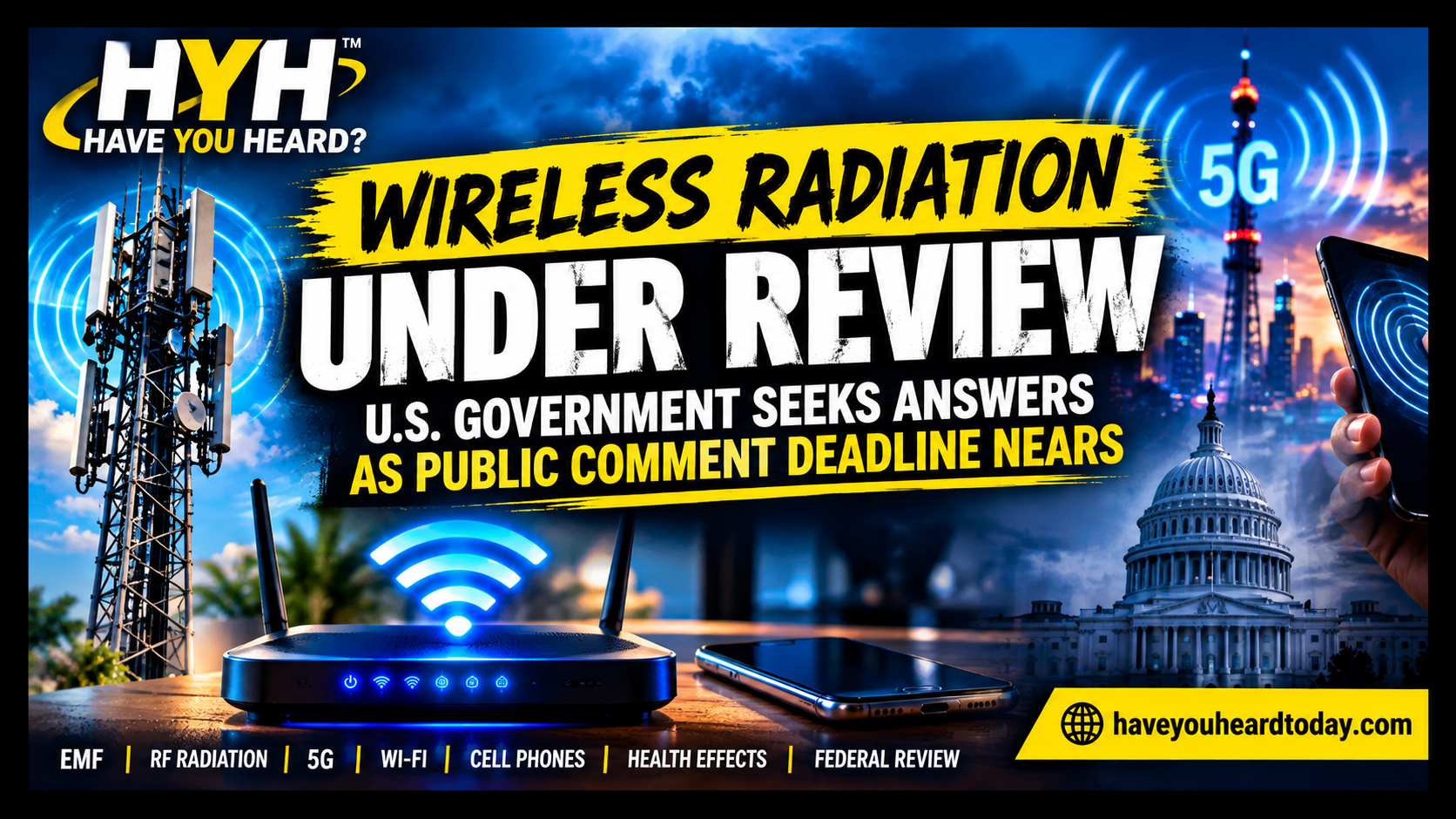
Wireless technology is woven into everyday life. Smartphones, Wi-Fi routers, cellular antennas and connected devices keep people communicating around the clock. But a renewed federal review is putting a familiar question back in the spotlight: what does the scientific evidence say about the potential health effects of wireless radiation?
In September 2026, the U.S. Department of Health and Human Services (HHS) formally asked researchers, medical professionals, industry representatives and members of the public to submit information about electromagnetic fields (EMFs), radiofrequency (RF) radiation and wireless exposure. The request is intended to help officials assess existing evidence, identify research gaps and consider whether changes to public guidance or regulatory approaches may be warranted.
The immediate development is the approaching deadline: comments on the HHS request are due October 21, 2026. The Federal Communications Commission (FCC) has also opened a separate, related comment process with a deadline of October 22.
What Exactly Is the Government Reviewing?
On September 17, HHS announced a Request for Information covering EMF exposure and human health, with particular attention to radiofrequency energy associated with wireless technologies.
The department is seeking scientific studies, technical data, clinical observations and other evidence that can help officials evaluate the current state of knowledge. Its questions include potential effects associated with long-term exposure, how exposure is measured in real-world settings, and whether existing U.S. and international safety standards should be reassessed.
HHS is also asking about potential research priorities involving children, pregnant people, older adults, people with implanted medical devices and workers who may experience higher occupational exposure.
This is a request for evidence, not an announcement that officials have concluded wireless radiation causes illness. The purpose is to gather information before drawing policy conclusions.
Why Is This Happening Now?
Wireless technologies continue to evolve, from widespread 5G deployment to emerging 6G research, satellite connectivity, wearable devices and increasingly connected homes.
HHS says it wants to evaluate the scientific evidence, identify areas where research remains incomplete and compare the approaches used to establish exposure standards in the United States and internationally.
The review follows a broader federal effort to examine environmental factors that may affect public health. It also creates a formal opportunity for researchers and members of the public to submit evidence directly to the department.
The FCC Has a Separate Deadline
There is another important part of the story. In September, the FCC sought additional comments on specific radiofrequency exposure issues following a federal appeals court’s 2021 decision in Environmental Health Trust v. FCC.
The court required the commission to provide further consideration and explanation concerning particular issues raised in its earlier review. These included questions involving children, long-term exposure, environmental effects and evidence cited in challenges to the agency’s conclusions.
The FCC’s notice does not mean the court ruled that wireless radiation causes cancer or other illnesses. The court did not decide the scientific debate; it directed the agency to address specified issues more fully.
The FCC’s separate comment deadline is October 22, 2026. The HHS and FCC processes address related subject matter, but they are different proceedings with different purposes.
Does This Mean Wi-Fi or 5G Has Been Proven Dangerous?
No. A government review is not proof that a hazard has been established.
Radiofrequency energy used by cellphones, Wi-Fi and cellular networks is classified as non-ionizing radiation. It differs from ionizing radiation, such as X-rays, which has enough energy to remove electrons from atoms.
According to the U.S. Food and Drug Administration, the weight of scientific evidence has not linked radiofrequency radiation from cellphones with health problems. The World Health Organization’s published overview of wireless technologies likewise says convincing evidence of adverse health effects from the low-level radiofrequency signals produced by base stations and wireless networks has not been established.
Those assessments do not mean every scientific question has been permanently settled. They do mean that the new federal information requests should not be presented as proof of harm. The evidence, the limits of existing research and any future conclusions need to be evaluated separately.
What Questions Still Need Answers?
The federal requests raise several areas for further examination:
- How well do current exposure measurements reflect people’s everyday use of wireless devices?
- What additional research would help clarify questions about long-term exposure?
- Are certain populations or occupational settings in need of more targeted study?
- How should scientists evaluate evidence from different study designs and distinguish association from causation?
- Do current exposure standards adequately account for the evidence and the technologies now in use?
These are questions for scientific evaluation, not conclusions that a particular device or network has been shown to cause harm.
What Happens Next?
The next immediate milestone is the close of the public-comment periods: October 21 for the HHS request and October 22 for the FCC proceeding.
After gathering submissions, officials can review the evidence and determine what further analysis, research or policy work may be appropriate. The requests themselves do not announce a new exposure limit, a ban on wireless devices or a final determination that current standards are unsafe.
The important development to watch is what the agencies conclude after reviewing the material—not simply the fact that they have asked for it.
The Bottom Line
Wireless radiation is back in the federal spotlight. HHS is seeking evidence about radiofrequency exposure and human health, while the FCC is separately revisiting specific questions concerning its exposure rules. Both processes have deadlines this week.
That makes this a significant public-policy development, but not proof that Wi-Fi, cellphones or 5G have been found dangerous. The real story is the government’s renewed examination of the evidence, the questions researchers are being asked to address and what the agencies may do next.
Have You Heard? will continue to follow the developments and distinguish verified announcements from speculation as new information becomes available.
Sources and Further Reading
- U.S. Department of Health and Human Services: Public input on electromagnetic fields and wireless radiation
- Federal Register: HHS Request for Information — deadline October 21, 2026
- Federal Communications Commission: RF exposure public notice
- Federal Register: FCC RF exposure proceeding — deadline October 22, 2026
- U.S. Food and Drug Administration: Radiofrequency radiation and cellphones
- World Health Organization: Wireless technologies and health
Have You Heard? reports on developing stories using official announcements and published evidence. An agency’s request for information should not be interpreted as a finding that wireless radiation has caused a particular health effect.