October 30, 2026 | Have You Heard? Original Public Safety Feature
Look around the next time you’re standing at an intersection, walking through a parking lot, or waiting at a traffic light.
How many people are looking down at their phones?
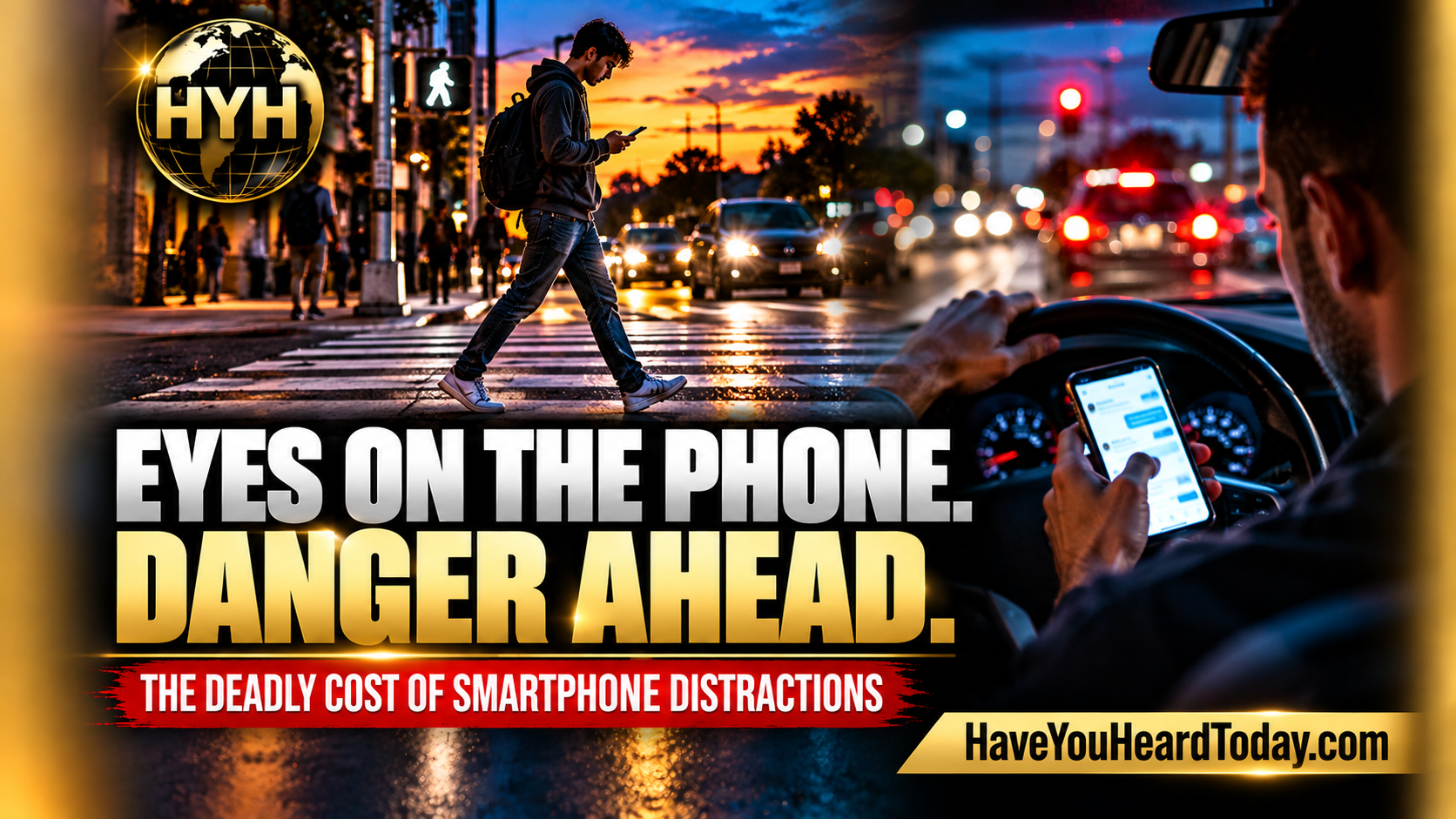
Some are reading messages. Others are watching videos, checking social media, following directions, or responding to notifications. Many continue walking without lifting their heads. Some do the same thing behind the steering wheel.
Smartphones have become essential tools in everyday life. But the convenience of having the world in our hands has created a troubling question:
Have we become so focused on what’s happening on our screens that we’re overlooking the dangers directly in front of us?
A Man Crossing the Street. A Phone in His Hand. A Life Lost.
On October 10, 2026, a 37-year-old man from Iowa was struck by a vehicle while crossing East University Avenue in Lafayette, Louisiana.
Police identified the pedestrian as Cody Sanson, of New Market, Iowa.
According to local reporting citing the Lafayette Police Department, preliminary investigators’ findings indicated Sanson was looking at his cellphone while crossing a poorly lit section of roadway without a designated crosswalk.
He was transported to a hospital, where he died.
Police said driver impairment was not a factor. The investigation was continuing, and the initial findings should not be treated as a final determination of every contributing circumstance.
The tragedy illustrates an important safety concern: pedestrians need to recognize approaching vehicles, changing traffic signals, road conditions, and other hazards. Looking down at a screen can interfere with that awareness.
A Father and Two Children Killed: A Truck Driver Sentenced
Another devastating case reached a sentencing milestone this October in Pennsylvania.
On October 13, 2026, a judge sentenced commercial truck driver Santos M. Valentin to a prison term of three years minus three days to 12 years following his conviction in a crash that killed a father and two children.
The collision occurred in July 2024 along the Pennsylvania Turnpike.
The victims were 43-year-old Donnell Hickson, his 18-year-old son Decir, and his 11-year-old daughter.
According to the Lancaster County District Attorney’s Office, investigators recovered inward- and outward-facing camera footage from the tractor-trailer showing Valentin scrolling on his phone before the collision.
The 47,000-pound tractor-trailer struck the family’s vehicle from behind.
Valentin was convicted of three counts of homicide by vehicle and three counts of involuntary manslaughter, along with traffic offenses.
The case demonstrates how distraction behind the wheel can devastate people who were simply sharing the roadway.
Utah: A Fatal Collision and New Allegations About Phone Activity
In a third case, a California woman was charged in October 2026 in connection with a fatal June 12 crash on Interstate 15 in Utah.
Prosecutors allege that Christine Chao accessed an adult-content website on her phone less than two minutes before a multivehicle collision in traffic slowed by construction.
The collision resulted in the death of 66-year-old Scott LaVar Lichfield, according to local reporting and court documents.
Investigators reportedly obtained phone records through a warrant. Chao was charged with a felony automobile-homicide offense related to electronic-device use.
These are allegations in an ongoing criminal case, not a conviction. The reported phone activity does not, by itself, establish exactly where the driver was looking at the moment of impact.
Still, the case adds to the national conversation about electronic-device use and roadway safety.
The National Numbers: Thousands of Lives Lost
In an April 2026 research note, the National Highway Traffic Safety Administration reported that distracted drivers were involved in crashes that killed 3,208 people in 2024.
The agency also estimated that another 315,167 people were injured in crashes involving distracted drivers that year.
Approximately 8% of fatal crashes in 2024 were reported as distraction-affected.
These figures include distractions beyond smartphones, such as adjusting controls, eating, talking to passengers, or looking away from the road. They should not be interpreted as a count of deaths caused exclusively by texting or cellphone use.
And because distraction can be difficult for investigators to establish, the full extent of the problem may not always be captured in crash reports.
Five Seconds: How Far Can a Car Travel?
According to NHTSA, reading or sending a text can take a driver’s eyes away from the road for about five seconds.
At 55 miles per hour, a vehicle travels roughly 403 feet in five seconds — longer than an American football field.
During that time, traffic can stop, a pedestrian can step into a crosswalk, a cyclist can change position, or a vehicle ahead can brake suddenly.
The danger is not limited to typing messages. Scrolling through social media, checking videos, interacting with apps, or reading notifications can also divert a driver’s attention.
Distracted Walking Deserves Attention Too
Drivers have a heightened responsibility because they operate heavy, fast-moving vehicles. But pedestrians also benefit from remaining aware of their surroundings.
When someone walks with their head down, they may be slower to notice a turning vehicle, uneven pavement, a bicycle approaching, or an intersection signal changing.
However, pedestrian distraction should not automatically be blamed whenever a person is struck. Road design, visibility, vehicle speed, driver behavior, and access to safe crossings all matter.
The broader lesson is that attention is a shared safety resource. People walking and driving need to recognize the conditions around them.
Why Is It So Hard to Put the Phone Down?
Modern smartphones combine communication, navigation, work, entertainment, shopping, and social interaction into one device.
Messages and notifications can create a powerful temptation to check what has arrived, even when the timing is unsafe.
Some people also underestimate how much attention a quick glance requires. A message that feels as though it takes only a moment can consume critical seconds of visual and mental focus.
Hands-free features may reduce the need to hold a device, but they do not eliminate every form of cognitive distraction.
Seven Habits That Could Help Prevent a Tragedy
- 1. Activate Driving Focus or Do Not Disturb. Silence nonessential notifications before starting the vehicle.
- 2. Set navigation before departure. If directions need to change, stop in a safe location before adjusting the phone.
- 3. Never text or scroll while driving. A red light or slow traffic does not make divided attention safe.
- 4. Pull over for important messages. Park safely before reading or replying.
- 5. Look up before crossing. Stop using your phone, follow crossing signals, and watch for turning vehicles.
- 6. Stay aware in parking lots. Watch for reversing vehicles, moving traffic, and pedestrians.
- 7. Speak up respectfully. If someone driving you is distracted, ask them to focus on the road.
A Question Worth Asking Ourselves
Smartphones connect us to the people we love, the news we follow, and the information we need. They are valuable tools.
But no message, video, notification, or social media update is worth a human life.
Behind every fatal crash statistic is a person who had plans, relationships, responsibilities, and people expecting them to come home.
The families affected by the recent tragedies in Louisiana, Pennsylvania, and Utah are reminders that the consequences extend far beyond a damaged vehicle or a traffic citation.
Have You Heard? Bottom Line: Our phones can wait. A moving vehicle cannot. And when we’re crossing a street, our eyes should be on the world around us — not just the screen in our hands.
Before you look down at your phone, ask yourself: What might I miss while I’m looking away?
Sources and Further Reading
- Lafayette local reporting — Pedestrian killed on East University Avenue, October 10, 2026
- Lancaster County District Attorney — Truck driver sentencing, October 2026
- FOX 13 Utah — Fatal I-15 collision and October charges
- NHTSA — Distracted Driving in 2024, published April 2026
- NHTSA — Distracted Driving: Risks and Prevention
Have You Heard? prepared this original public-safety feature using verified news reports, prosecutorial information, and federal traffic-safety research. Allegations and preliminary investigative findings are identified as such.