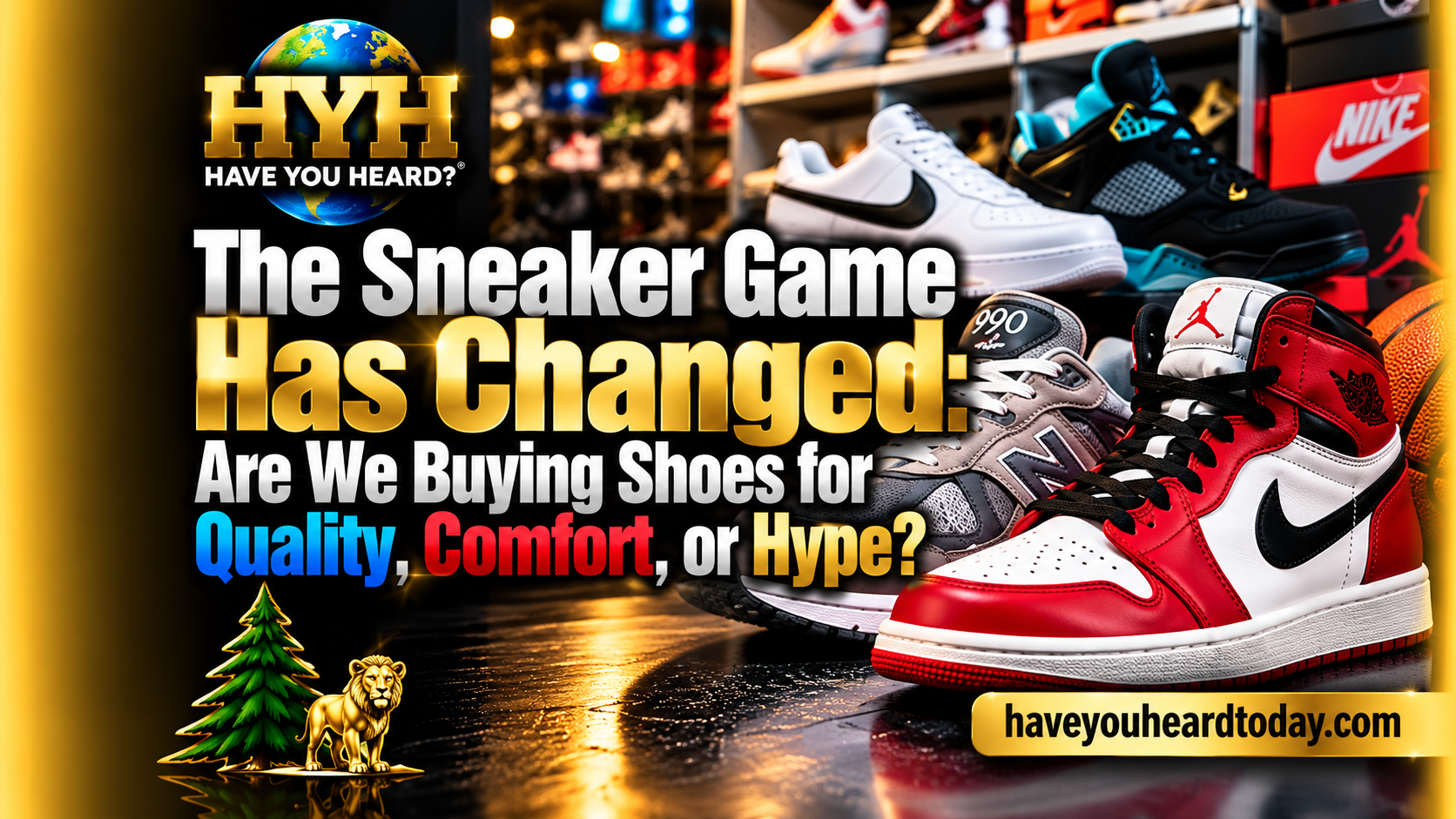
HYH ORIGINAL | October 26, 2026
From classic Air Jordans to New Balance, Adidas, Nike and today’s resale market, the sneaker game is about more than footwear. It’s about identity, memories, comfort, craftsmanship and the price we’re willing to pay to stand out.
There was a time when getting a fresh pair of sneakers meant something special. You might have saved up for weeks, waited for a particular colorway, or carefully kept the box because those shoes were more than something to wear.
For many people, that feeling never went away.
But the sneaker game has evolved. Limited releases, celebrity collaborations, online resale platforms and social media now compete for our attention. A shoe can become a conversation piece before anyone has even tried it on.
That raises a question worth asking: Are we buying sneakers because they’re genuinely good shoes, or because everyone else wants them?
When Sneakers Became Part of Our Identity
Sneakers have long connected sports, music, fashion and everyday life. Basketball helped turn performance footwear into cultural icons, while hip-hop and streetwear helped establish sneakers as a form of personal expression.
For some people, the appeal is the history behind a pair of Jordans. Others prefer the simplicity of Adidas classics, the familiar feel of a New Balance running shoe or the latest Nike innovation.
And sometimes the most meaningful pair isn’t expensive or rare at all. It’s the one that reminds you of a particular time in your life.
That’s one reason sneaker culture cannot be measured by resale prices alone. Personal attachment is something a price chart cannot capture.
New Balance Is Betting on Quality and Heritage
One of the clearest examples of the relationship between sneaker history and modern design arrived on October 22, 2026, when New Balance introduced its Made in USA 990v7.
The 990 series dates back to 1982, when the original model entered the market as a premium running shoe. Over the decades, it developed a following among people who appreciated its understated appearance and everyday versatility.
The upcoming 990v7 combines familiar design elements with updated cushioning and support. New Balance has announced a November 6, 2026 release at a suggested U.S. retail price of $200.
That price puts it firmly in premium territory. But it also invites an interesting comparison: Is the buyer paying for comfort, construction, heritage, branding or some combination of all four?
New Balance’s approach suggests that a sneaker doesn’t have to look completely different every season to remain relevant. Sometimes, improving a familiar design is the entire point.
Related reporting: New Balance’s October 22 announcement of the 990v7.
Why Retro Jordans Still Matter
Meanwhile, Jordan Brand continues to revisit designs connected to earlier eras of basketball and sneaker culture.
October’s release calendar includes the Air Jordan 14 “Forest Green,” scheduled to return October 31 after originally appearing in 2005.
For longtime collectors, a retro release can feel like an opportunity to revisit a moment they remember. For younger buyers, the same shoe might represent a chance to experience a design they missed the first time.
That’s the unusual power of a classic sneaker: Two people can buy the same pair for entirely different reasons.
Of course, nostalgia does not automatically guarantee comfort or value. A retro shoe may look fantastic on a shelf while a less celebrated model better suits someone’s daily routine.
Related reporting: Sneaker News’ October 2026 Air Jordan release calendar.
Is the Resale Hype Finally Cooling Down?
For years, certain sneaker releases were difficult to purchase at their original retail prices. Some buyers turned to resale platforms, where limited availability and intense demand could push prices much higher.
But not every new sneaker becomes an instant collectible.
An October 9 report on the resale market cited an analysis by Needham analyst Tom Nikic. Of 30 sneaker launches examined for September, 13 sold out through primary retail channels and subsequently traded above retail prices. The average resale premium among those high-demand releases was 27%.
Those figures describe a particular group of releases, not the entire sneaker market. Still, they challenge the idea that every anticipated drop is destined to become a profitable resale item.
For ordinary sneaker fans, less intense resale demand could mean more opportunities to purchase a desired pair without paying an enormous markup.
For collectors who treat sneakers as investments, the lesson may be different: Popularity today is no guarantee of resale value tomorrow.
Related reporting: October 9 analysis of sneaker resale trends.
Comfort Is Changing the Fashion Conversation
There’s another development worth watching. Some consumers are embracing footwear that prioritizes comfort, unconventional shapes and personal expression over traditional ideas of what looks fashionable.
An October 25 report from The Guardian examined growing interest in unusual footwear, including minimalist and hybrid styles that challenge familiar fashion rules.
Not all those designs are conventional sneakers, but the trend matters to the broader shoe industry. It suggests that shoppers are increasingly willing to decide for themselves what looks and feels right.
A sneaker doesn’t have to be the most expensive, the rarest or the most talked-about pair to become someone’s favorite.
Related reporting: The Guardian’s October 25 footwear trend report.
Authentic Sneakers: More Than a Logo
In sneaker culture, the word authentic carries at least two meanings.
First, there’s product authenticity: whether a pair is genuine rather than counterfeit. Buyers considering expensive or limited-edition sneakers should pay attention to the seller’s reputation, return policy, purchase documentation and the details of the specific model.
Even authentication services can make mistakes, so a single label or online photo should not be treated as an absolute guarantee.
Then there’s personal authenticity: choosing a sneaker because it fits your taste, lifestyle and budget instead of buying it simply to impress other people.
Those two forms of authenticity are related, but they are not identical. A genuine designer sneaker can still be a poor purchase for someone who finds it uncomfortable or cannot reasonably afford it.
What Makes a Sneaker Worth the Money?
Before spending serious money on your next pair, consider a few practical questions:
- Comfort: Does the shoe fit properly and support the activities you actually do?
- Construction: Do the materials, stitching and overall finish meet your expectations?
- Durability: Is the shoe appropriate for how often and where you plan to wear it?
- Price: Are you comfortable paying the retail price, or are you reacting to limited availability?
- Personal style: Would you still want the pair if nobody recognized the brand or model?
There is no universal winner. A performance running shoe, a retro basketball sneaker and a casual everyday shoe are designed for different purposes.
And a higher price does not automatically mean a better fit, longer lifespan or more enjoyable ownership experience.
The HYH Perspective: Buy What You Love, Not Just What Trends
The sneaker game isn’t disappearing. It’s becoming more varied.
Some buyers want cutting-edge technology. Some want the history of an iconic silhouette. Others simply want a clean, comfortable pair of shoes that looks good with their favorite outfit.
All three approaches belong in sneaker culture.
What’s changing is the amount of information available to consumers. Release calendars, product reviews, resale histories and online discussions make it easier to compare options. They also create more pressure to chase whatever is trending.
At Have You Heard?, our view is simple: A great sneaker should earn its place in your collection, not just its place on your social media feed.
The best pair isn’t necessarily the most expensive. It might be the one you wear so often that you eventually need another.
Have Your Say: What’s Your Sneaker Loyalty?
If you could wear only one sneaker brand for the next five years, which would you choose?
A. Nike
B. Jordan Brand
C. Adidas
D. New Balance
E. Another brand entirely
And one more question: Would you rather own one expensive limited-edition pair or three comfortable everyday pairs?
Share your opinion. The sneaker conversation belongs to everyone who has ever appreciated a fresh pair of kicks.
Sources and Further Reading
- New Balance — Made in USA 990v7 announcement, October 22, 2026.
- Sneaker News — October 2026 Air Jordan release calendar.
- Sneaker resale market analysis, October 9, 2026.
- The Guardian — Changing footwear trends, October 25, 2026.
HYH Original: Independent editorial analysis based on publicly reported sneaker industry developments. No firsthand product testing or interviews are claimed.