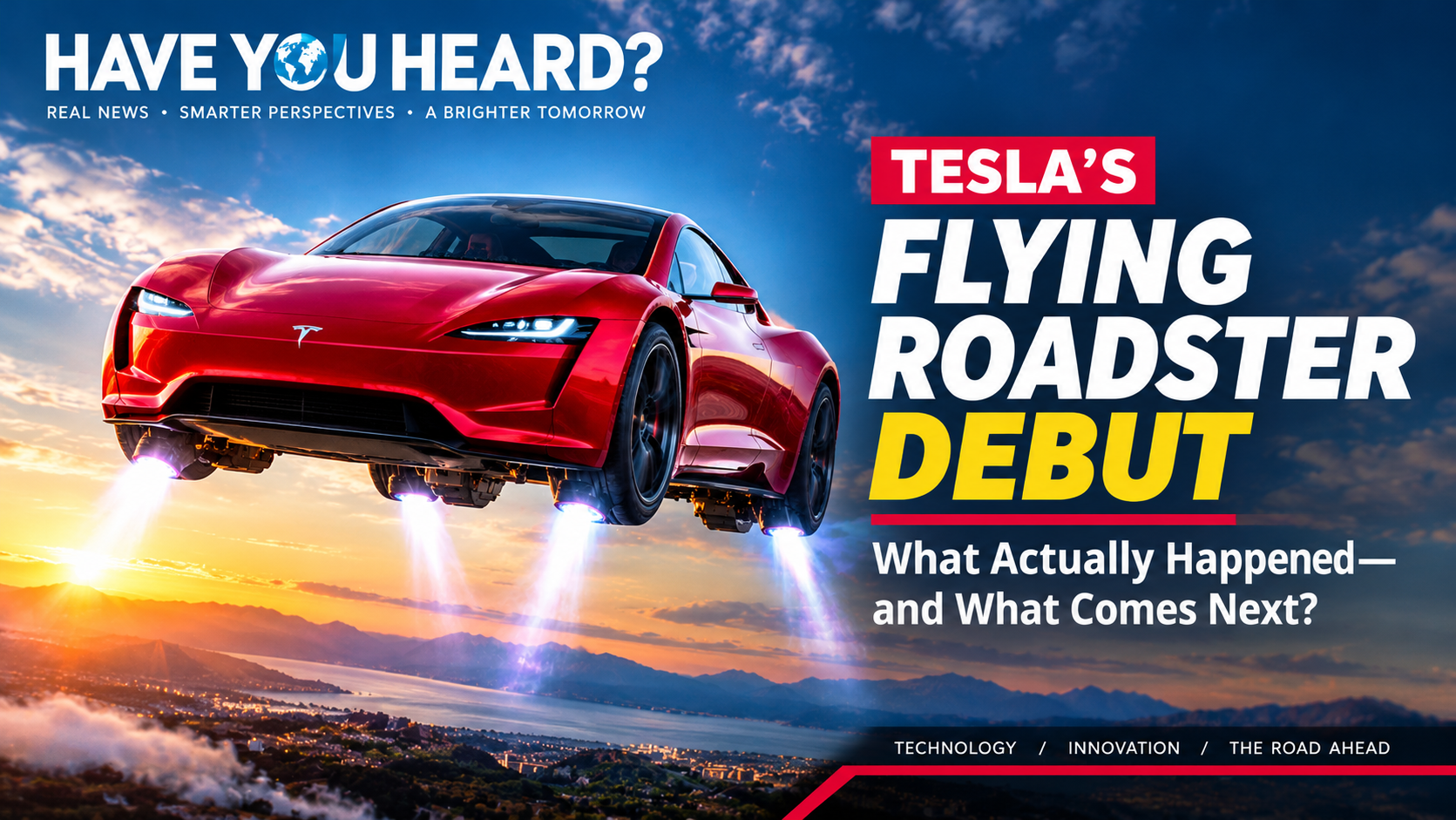
Tesla’s Flying Roadster Debut: What Actually Happened—and What Comes Next?
Published October 17, 2026
The idea of a car that can leave the road and take to the sky has fascinated people for generations. On October 15, Tesla demonstrated its long-awaited next-generation Roadster at a SpaceX testing facility in Texas.
The demonstration was extraordinary. But beneath the excitement is a more important question: Did Tesla unveil a practical flying car, or demonstrate a high-performance electric sports car capable of brief, rocket-assisted airborne maneuvers?
What Happened at Tesla’s Roadster Debut?
Tesla CEO Elon Musk presented the new Roadster during a demonstration livestreamed to the public. The vehicle climbed a curved ramp, traveled upside down, launched into the air, performed a midair maneuver, and landed on its wheels. It also demonstrated a jump over a line of parked Tesla vehicles.
According to Associated Press reporting, the Roadster uses cold-gas thrusters and a suction system to perform its unusual maneuvers.
The event offered a glimpse of technology that would have seemed more at home in science fiction only a few decades ago. However, a dramatic demonstration is not the same as proving that a vehicle can safely fly between destinations.
How Does the Flying Roadster Work?
Unlike conventional electric vehicles, which depend on tires for movement and traction, the rocket-equipped Roadster is designed to use cold-gas thrusters to generate additional force.
During the demonstration, the thrusters helped propel the vehicle through brief airborne maneuvers. A suction-based system also helped the car maintain contact with a specially designed curved surface.
These technologies serve different purposes. Suction can help maintain contact with a surface, while thrusters can provide force to move the vehicle away from it.
Although the demonstration was striking, it did not establish that the vehicle can sustain controlled flight over meaningful distances or operate like a conventional aircraft.
Is It Really a Flying Car?
The answer depends on what qualifies as flying.
The demonstration showed the prototype becoming airborne and performing brief maneuvers. That is not the same as demonstrating a vehicle that can take off, travel through the air, navigate obstacles, and land safely at an intended destination.
A practical flying vehicle would need to address challenges including stability, energy or propellant requirements, emergency procedures, airspace rules, and the safety of people on the ground. It would also need to meet applicable regulatory requirements before being operated in public.
For now, the fairest conclusion is that Tesla has demonstrated a prototype capable of brief airborne maneuvers—not a proven replacement for conventional transportation.
When Could Consumers Get One?
Musk has indicated that Tesla is targeting production in 2028. That remains a future target rather than a completed milestone.
The rocket-equipped version has been presented as an exclusive offering. Its eventual availability, final specifications, pricing, and regulatory status remain important considerations for potential buyers.
The production timeline is worth watching, particularly because the next-generation Roadster program has experienced years of delays since it was originally announced.
Until production vehicles are delivered and independently evaluated, consumers should distinguish between the capabilities shown in a demonstration and the specifications of a finished product.
What This Debut Could Mean for the Future of Transportation
Tesla’s demonstration raises a larger question about how far electric vehicles and aerospace technology might eventually converge.
Advances in propulsion, materials, vehicle control, and energy storage could contribute to new forms of transportation. Companies developing electric vertical takeoff and landing aircraft are also pursuing ways to move people through the air without relying on traditional runways.
But combining a road vehicle and an aircraft creates difficult engineering trade-offs. A car must withstand road impacts and protect passengers, while an aircraft must meet demanding requirements for lift, stability, and efficient flight.
The Roadster demonstration is a reason to pay attention to the technology. It is not, by itself, proof that everyday flying cars are ready for consumers.
The HYH Perspective: The Spectacle Is Only the Beginning
Tesla’s Roadster debut delivered the kind of demonstration that captures public attention. The more consequential test, however, comes after the cameras stop rolling.
Can the technology be produced reliably? Can the vehicle perform safely outside a controlled demonstration? Will regulators permit the intended uses? And will the final product deliver the capabilities being promoted at a price consumers can justify?
Those questions will determine whether this is a turning point in transportation or an ambitious engineering showcase.
For now, Tesla has given the public a dramatic preview of what rocket-assisted automotive technology might achieve. Whether that preview becomes a practical transportation option remains to be seen.
Have You Heard? The next major milestone will not simply be another airborne stunt. It will be evidence that the technology can move from demonstration to a safe, usable, and commercially available vehicle.
Sources and Further Reading
- Associated Press: Tesla’s new Roadster can thrust itself in the air
- CNN: Tesla unveils what it says is a flying car
- CBS News: Tesla’s Roadster debut and the flying-car question
- Tesla: Roadster
Have You Heard? reports on the latest developments in technology, business, science, and the stories shaping everyday life.
Leave a Reply